🎧 Listen to this article (5 min)
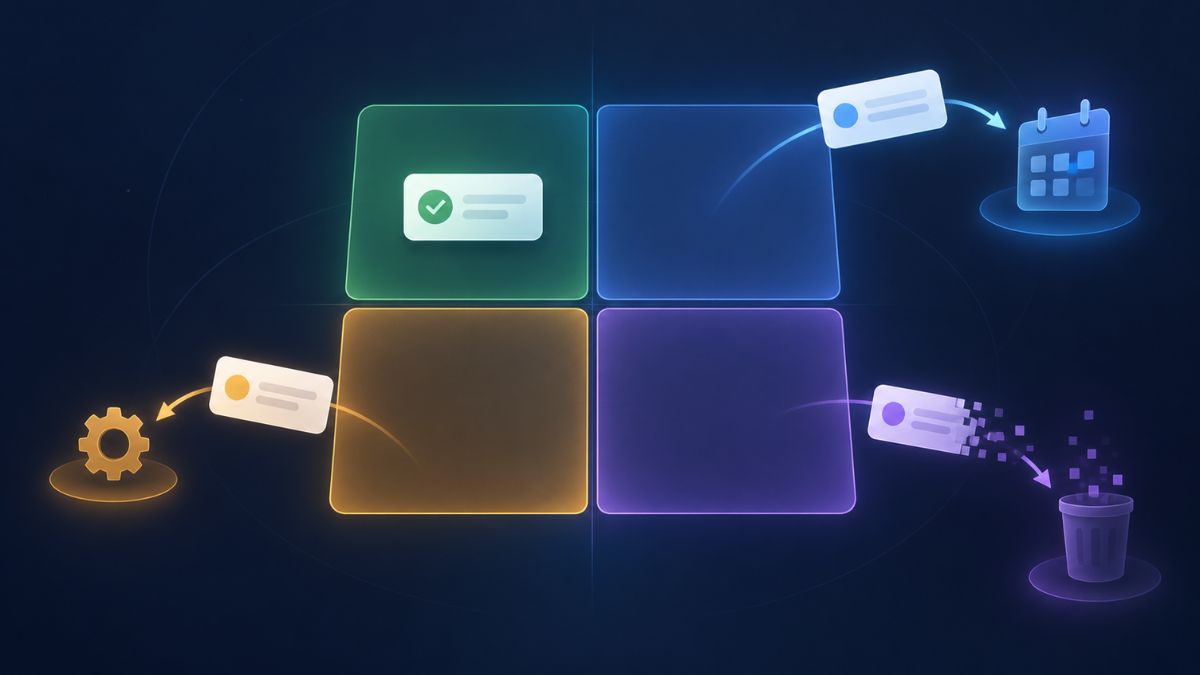
Most people do not have a problem finding things to do. They have too many things already in progress.
I notice this in my own work. A half-written article, a website that needs finishing, an email waiting for a reply, and a product idea started last week can each feel harmless. Together, they create drag.
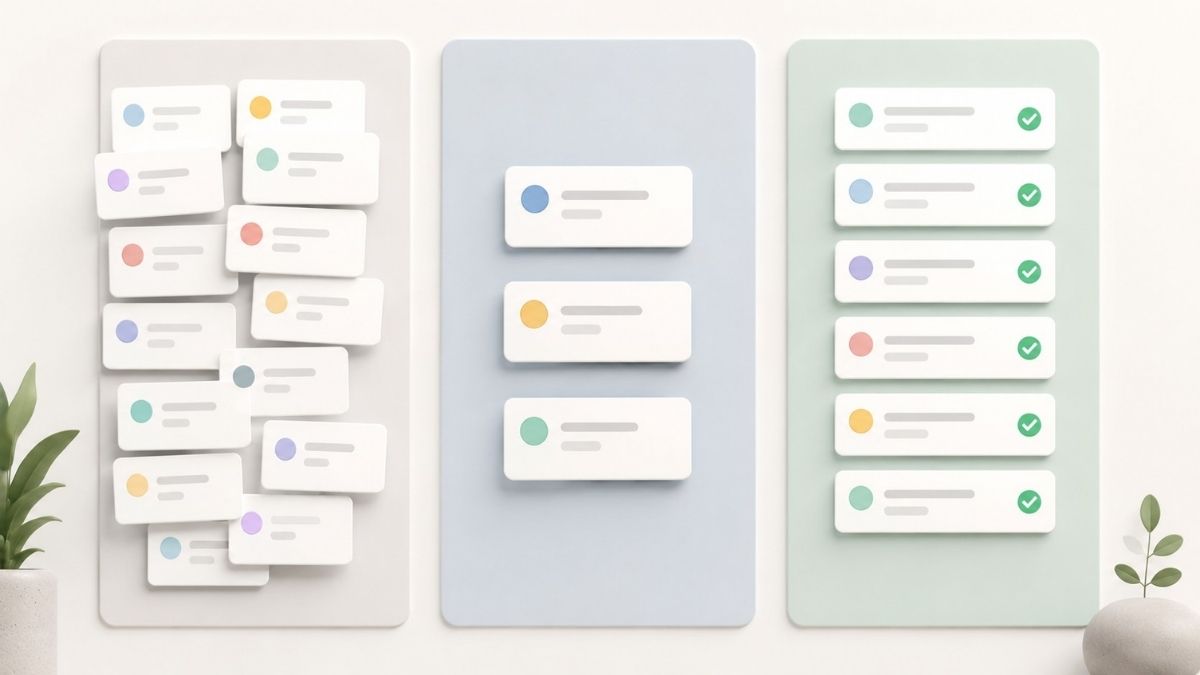
Kanban is useful because it makes that drag visible. At its simplest, a personal Kanban board might have three stages: To Do → Doing → Done.
That seems almost too obvious to be useful, but the important part is not the columns. It is what happens when you limit the middle one.
The problem with unfinished work
Imagine you have ten tasks. You could work through them one at a time, or start all ten and make a little progress on each.
The second approach feels productive because everything is moving, but very little is finished. Every unfinished task occupies some mental space: where you stopped, what comes next and why you started it. The cost is not just time. It is attention.
Kanban is about flow
Kanban has roots in the Toyota Production System, where downstream demand signalled upstream processes to produce only what was needed. Toyota had adopted Kanban across all its plants by 1963.
The modern Kanban Method for knowledge work came much later, with David J. Anderson developing an early pull system at Microsoft in 2004 before codifying the approach in his 2010 book, Kanban: Successful Evolutionary Change for Your Technology Business.
The important connection is not the history itself. It is the idea that work should be pulled through a system rather than continually pushed into an already busy one.
A traditional to-do list tells you how much work exists. A Kanban board tells you where the work is.
The most important column is Doing
When I built my Kanban Learning Lab, I deliberately limited the Doing column to three tasks. Three is not a universal Kanban rule; it is a teaching constraint.
You add one task, then another, then a third. Now you want to start something else, but you cannot. That tiny moment of friction is where the lesson begins.
You have to decide whether the new task really needs starting now, whether one of the existing tasks can be finished first, or whether something is blocked. Without a limit, starting something new is easy. With a limit, you have to manage what you have already started.
The question changes from What else could I start? to What should I finish?
Stop starting. Start finishing.
“Stop starting, start finishing” has become a familiar mantra in the Kanban community, and for good reason. Starting creates novelty and momentum. Finishing often means dealing with the awkward last ten percent: testing, editing, fixing, deciding, publishing or sending.
That is why starting can become a form of avoidance. We can remain extremely active while continually postponing completion.
A WIP limit is not magic. Work can be genuinely blocked by a client, supplier or colleague, and some roles require several live threads at once. The point is not to treat three as a fixed rule, but to make unfinished work visible and choose deliberately how much you can carry.
Movement is not progress
There is another trap: turning Kanban itself into a productivity hobby. You can create more columns, add colours, label everything and rearrange cards without finishing anything.
Moving a card is not the goal. Reaching Done is.
A useful system should reduce the attention needed to manage work, not create another layer of work to manage. The best Kanban board may therefore be quite boring.
The same principle, different work
The stages can change depending on the kind of work. A writer might move from Ideas → Writing → Editing → Published, while a designer might move from Brief → Designing → Review → Delivered.
The labels are different, but the principle is the same. Work enters a system, moves through it and eventually leaves.
Learn it by using it
You can understand Kanban intellectually in a few minutes, but experiencing the constraint makes the lesson clearer. That is why the Kanban Learning Lab in my Toolkit is deliberately small: it is there to teach the idea, not replace a full project-management system.
Sometimes productivity is not about finding a better way to do more things. It is about reducing how many things you are trying to do at once.